Serious engineering, rigorous method and occasionally an investigation that began as an argument in the Senior Common Room.

Research at King Ethelred’s combines first-principles analysis, experiment, simulation and the traditional British technique of staring at a graph until it becomes embarrassed and explains itself.
Low-speed flow, historic aircraft, roughness, corrugation, boundary-layer behaviour and why the wind tunnel smells faintly of paraffin.
Deterministic control, resource-constrained computing and the long tradition of tiny computers being asked to do unreasonable things.
Resilience, safety engineering, railway leaves, kettles and other hostile operating environments.
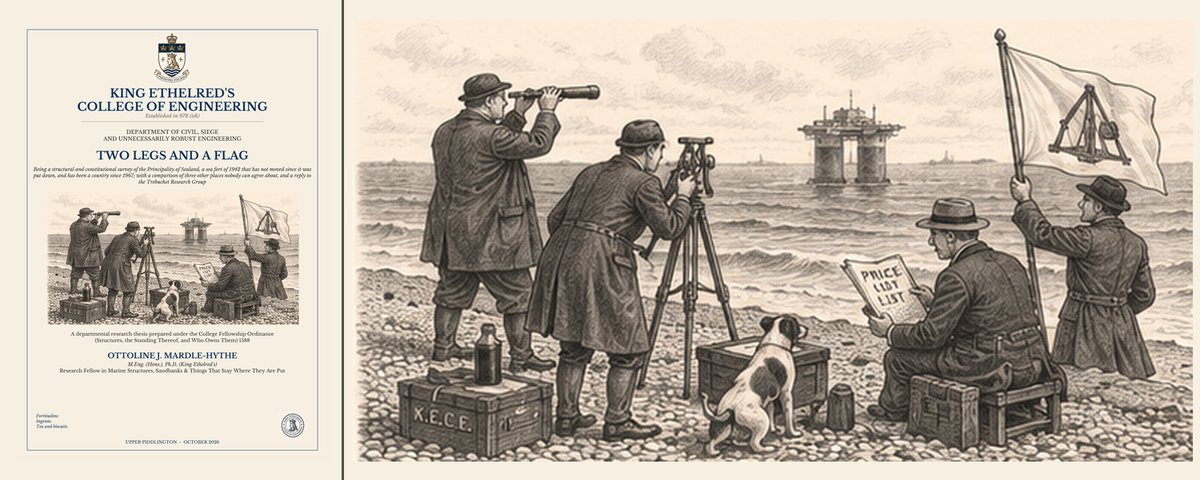
Being a structural and constitutional survey of the Principality of Sealand, a sea fort of 1942 that has not moved since it was put down, and has been a country since 1967; with a comparison of three other places nobody can agree about, and a reply to the Trebuchet Research Group.
The Trebuchet Research Group applied to declare its defence area on the water meadow independent, citing a precedent: HM Fort Roughs, a Maunsell sea fort sunk onto Rough Sands at 16:45 on 11 February 1942, held by the Bates family since 1966 and declared the Principality of Sealand on 2 September 1967. Dr Ottoline J. Mardle-Hythe surveyed it from the record, as a structure and as a state. The fort has not moved. The Royal Engineers blew up its sister fort twelve days before Sealand was declared; an English court found in 1968 that the fort lay beyond its reach; Britain’s territorial sea widened from 3 to 12 nautical miles in 1987 and passed over it; and the only part of Sealand known to have moved is a postage stamp, which went into space.
A Sealand Lord costs £24.99 and a Count £199.99, so that a Count is eight Lords and seven pence. The paper compares Hans Island, divided in 2022 after decades of bottles; Pheasant Island, which changes countries every six months without moving; and Bir Tawil, which no country claims.
A sea fort sunk on a sandbank in 1942, and held by one family since 1966, is sound as a structure and unrecognised as a state, and its titles are keenly priced. The Trebuchet Research Group’s application is refused. The fort has not moved. Neither has the Government. The border has.
The fort, its history, the court case, the events of 1978, the law, the prices and the three comparison territories are real and referenced, among them an interview with Michael and Liam Bates published this month. The College, the Trebuchet Group’s application and every finding are fiction. The Bates family are real people, and the paper’s humour is at the expense of the law, the price list and the College, not theirs.
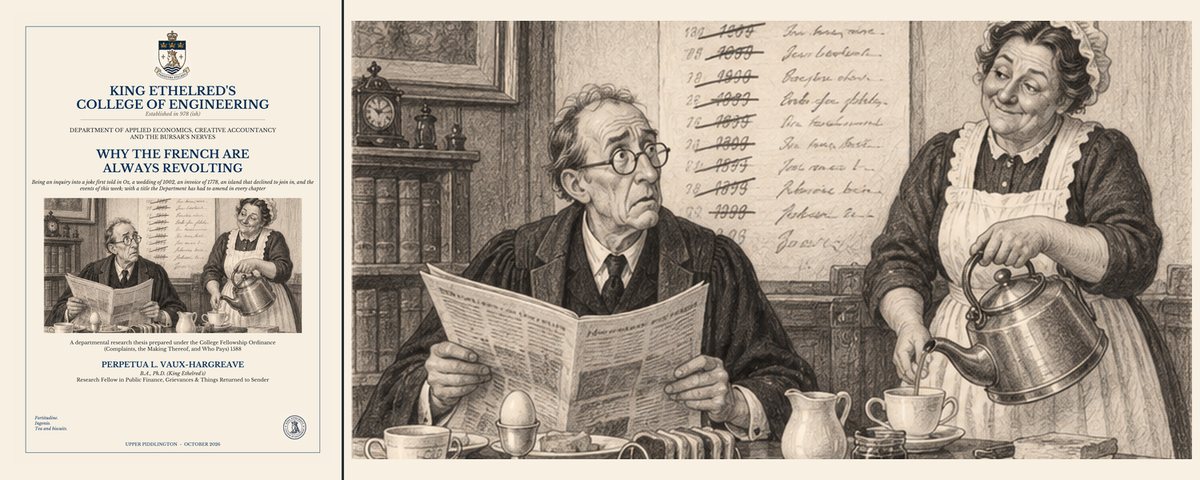
Being an inquiry into a joke first told in Oz, a wedding of 1002, an invoice of 1778, an island that declined to join in, and the events of this week; with a title the Department has had to amend in every chapter.
On the tenth day of the French school protests the Bursar read the paper, said that the French were always revolting, and Mrs Partridge said he could say that again. Dr Perpetua L. Vaux-Hargreave was asked to find out whether he was right. Her findings ruined one another in order. The joke is American: its first known telling is in The Marvelous Land of Oz, 1904, and it reached Louis XVI only in 1963. The habit is six and a half centuries old and named the barricade, after a barrel, without inventing it. 1066 was not a French revolt, and the College’s own namesake made the introductions, marrying the Duke of Normandy’s sister in 1002 after failing to kidnap the Duke. The English, scored on the College’s new Unrest Impact Index, turn out to have done it first and sent for the monarchy back. Jersey, chosen as a control group for being near France and not French, rioted over bread in 1769 and got a constitution.
The spine is an invoice. France paid to help the Americans revolt against Britain, the Americans went back to trading with Britain, and the debt contributed to the crisis that made the King summon the Estates-General for the first time since 1614, with everybody bringing a book of grievances. Those books were opened again in 2018. This week a government again stands between students in the street and a debt it cannot easily enlarge, and the students are asking for teachers and buildings, which a college can only agree with.
The French are not always revolting. They are, however, unusually reluctant to regard an election as the final opportunity to express an opinion, and keep a book of grievances in a drawer for the purpose. Jersey agrees in principle, while reserving its constitutional position and requesting that the College stop calling it British.
The joke’s history, the events from 1229 to this week, the figures, the statements of ministers and students and the poll are real and referenced, and where a source corrects a popular belief the paper follows the source. The College, the Revolt Classification Office, the Bursar’s invoices and the findings are fiction. This month’s protests have injured hundreds of people, most of them teenagers; the paper reports that plainly and does not joke about it, nor about the Terror.
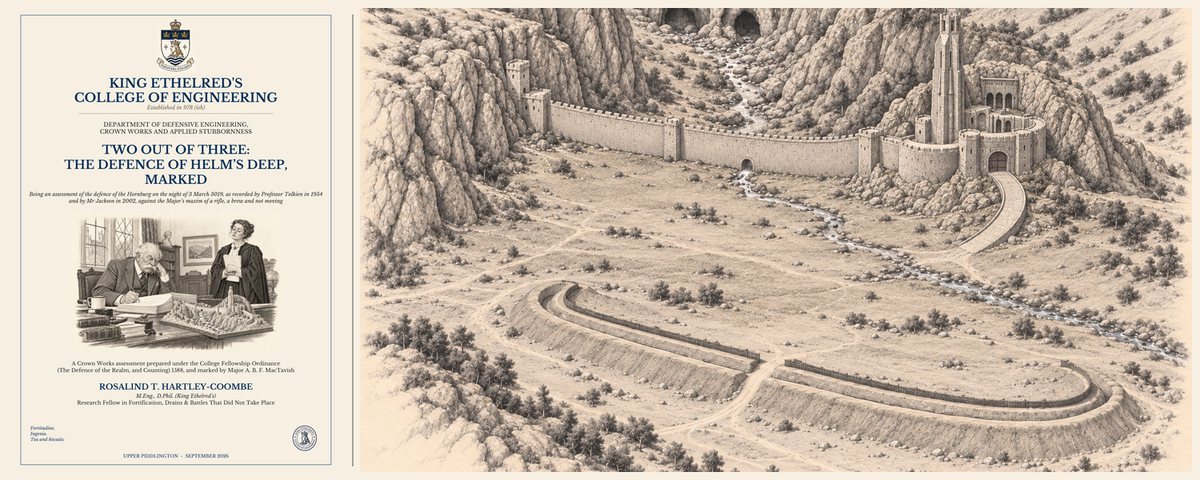
Being an assessment of the defence of the Hornburg on the night of 3 March 3019, as recorded by Professor Tolkien in 1954 and by Mr Jackson in 2002, against the Major’s maxim of a rifle, a brew and not moving.
The Major holds that most strategic problems can be addressed with a rifle, a brew and not moving. The Department tested the maxim at Rorke’s Drift and at Jadotville and wanted a third case, with one of the three missing. Helm’s Deep is that case: two thousand men of Rohan behind a wall twenty feet high, ten thousand against them, a night, and a relief at dawn. The Department is aware that the battle did not take place. It has assessed it anyway, on the ground that nobody has told the Major. Dr Rosalind T. Hartley-Coombe wrote it and the Major marked it in red.
The defence had no rifle, and its arrows ran out before midnight. It had a brew, in caves a short way up the gorge that were well provisioned and that nobody walked to. It did not move, until the King rode out at dawn. The wall, which stood against a hundred ladders, fell to the culvert that let the stream out, which had no grating; Mr Stobbs, who has kept one on the College’s culvert since 1987, wrote that chapter himself. The count of Gimli and Legolas, 42 to 41, has been audited by Dr Pemberton-Wolfe and declared a draw. The author of the book thought the battle incidental, drew the fortress on an examination script, and had the matter settled by a forest because Macbeth had disappointed him at school.
Helm’s Deep scores two out of three and was rescued by a forest. The Wall was twenty feet high and fell to its own drain; the arrows ran out before midnight; the provisions were a short walk away and nobody walked. The Major has passed it, with reservations, and would like the film back in the Library by Friday.
For once both halves are invented, and the paper says so. The battle is fiction by J. R. R. Tolkien and the film an adaptation by Peter Jackson; both are quoted briefly, attributed and analysed as published accounts. What is real: the texts, the author’s letters and drawing, Fonstad’s measurements, the sieges of Rochester and Château Gaillard, Rorke’s Drift and the arithmetic. What is the College’s: the Department, the Major’s marks, Mr Stobbs’s chapter and the grating.
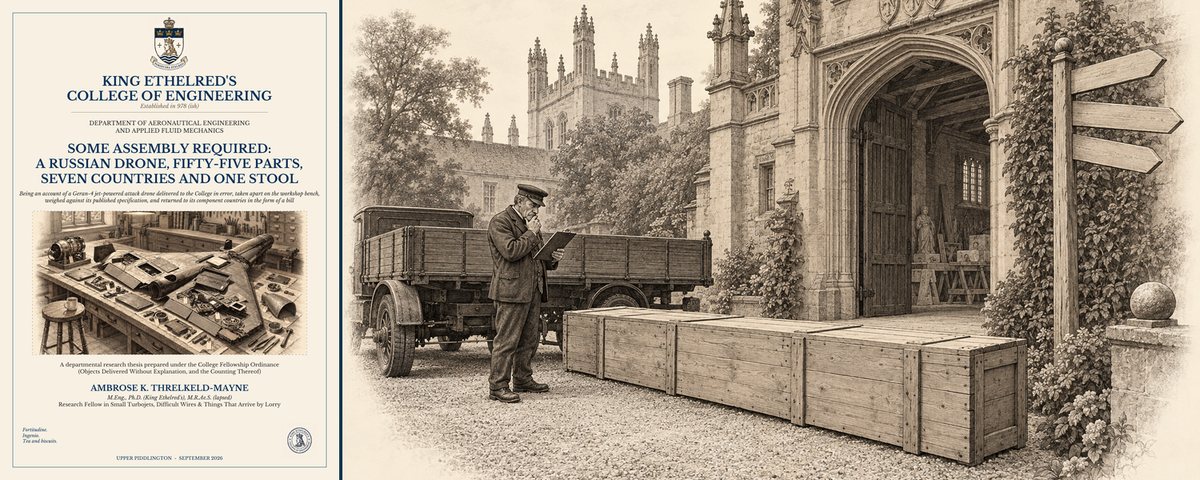
Being an account of a Geran-4 jet-powered attack drone delivered to the College in error, taken apart on the workshop bench, weighed against its published specification, and returned to its component countries in the form of a bill.
On Monday 21 September 2026 a crate followed the College signpost marked “Deliveries” to the workshop and was signed for. Inside was a Geran-4, the jet-powered drone Russia has flown against Ukraine since May, airframe complete, warhead absent, paperwork limited to a label. The College does not know who sent it and has asked. Dr Ambrose K. Threlkeld-Mayne took it apart on the bench at Gerald’s end, counted what he found, and set the count beside the list Ukraine’s Defence Intelligence publishes from the wreckage of real ones: 55 identified components, 24 from the United States, 15 from China, two each from Germany, Japan and Great Britain, one each from Taiwan and Switzerland, eight unknown. Texas Instruments alone accounts for twelve.
The engine is Chinese, the camera is Chinese, the mesh modem is Chinese, the tracker carries mobile-telephone modems, SIM cards from four countries and a Raspberry Pi, and what is Russian, the specialists who took a real one apart say, is mainly the body and the assembly. The family began as an Iranian propeller drone of 185 km/h that Russia bought six thousand of at $193,000 each and now builds at Alabuga for a quarter of that; the jets are intercepted 60 per cent of the time against 95 for the propeller types, by fighters and by missiles that cost twenty times the target. The Department put the airframe in the Sir Barnes Wallis Subsonic Wind Tunnel and confirmed, at some expense, that it is subsonic. Miss Catchpole has filed the Raspberry Pi under “Apparatus, British, abroad”. Gerald’s connector fitted.
A Russian drone described as domestically produced contains more American parts than Chinese ones, two British ones, and one connector that fitted only because Gerald had it. The part that matters is the engine, the engine is Chinese, and the difference it makes is the difference between a rifle and a missile. The College has counted the parts and asked for the crate to be collected. Nobody has come.
The Geran family, its specifications, Ukraine’s component lists, the interception rates, the prices, Alabuga and the production figures are real and referenced, and where sources disagree the paper gives all of them. The crate, the teardown, the wind-tunnel run, the Bursar’s card and the interceptor trials are fiction and say so. Nothing was flown. The jokes are about the College, the supply chain and the paperwork, not about the people under the drones.
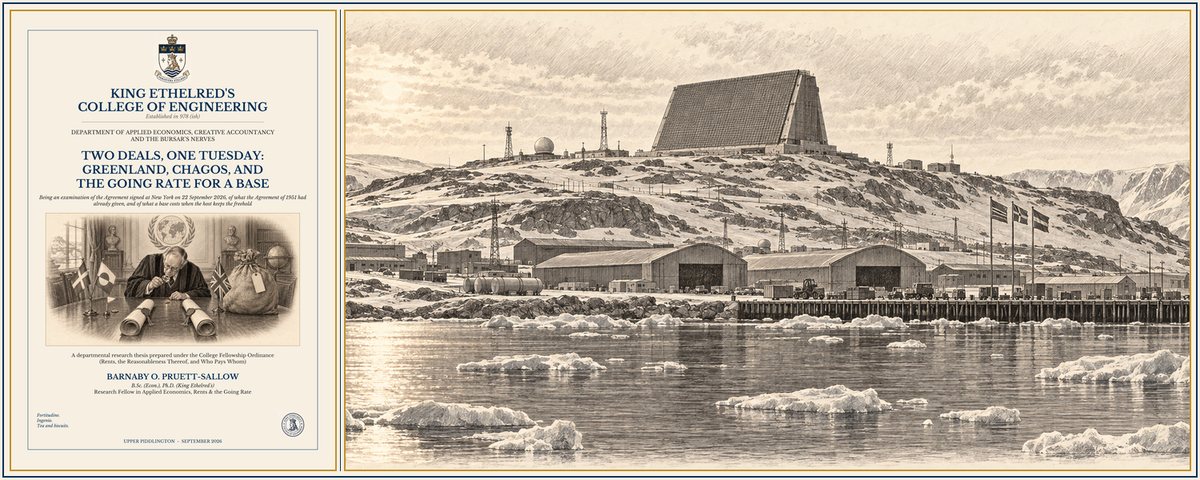
Being an examination of the Agreement signed at New York on 22 September 2026, of what the Agreement of 1951 had already given, and of what a base costs when the host keeps the freehold.
On the morning of Tuesday 22 September 2026 the President of the United States, the Prime Minister of Denmark and the Prime Minister of Greenland signed an Agreement on the defence of Greenland which the President described as “permanent control over security and all other needs on that territory” at “no cost to the United States”. That afternoon, in the same building, he called Britain’s arrangement for Diego Garcia terrible. The Bursar asked for the Greenland text to be read at once, on the ground that somebody, somewhere, had got a base for nothing, and he wished to know how. Dr Barnaby O. Pruett-Sallow read it against the Agreement of 1951 it amends, article by article.
The answer to the reader’s question, whether it is mainly bravado and not very different from what 1951 already gave, is: mostly, and not entirely. The 1951 text already gave bases by mutual agreement without limit, overflight and landing anywhere, movement by land, sea and air, unlimited troops and no rent, from a treaty a Danish minister first signed without orders in 1941 and was charged with treason for. What is new is eternity: no end date, and an undertaking that an independent Greenland keeps the bases and stays in NATO, which makes independence dearer. Sovereignty stays with Denmark in the preamble; the Greenlanders are named in the text as a people, and their Prime Minister signed. The Danish press called it a Danish victory and asked that the President not be told. The Department names this the Danish method, drafts it for Diego Garcia in two pages, and tests it on the water meadow, where the Trebuchet Research Group has been given permanent control and the Trebuchet has not moved.
Denmark gave the United States, in writing and for ever, what it had given in 1951, kept the freehold, paid nothing, put the Greenlanders’ names in the treaty and let the guest call it control. Britain proposes to give the freehold of Diego Garcia to a third party, pay £101 million a year, ask nobody, and be told by the same guest that it is terrible. The base is the same base. The difference is who kept the keys, and the going rate, established on Tuesday, is nil.
The Agreement of 22 September 2026, the Agreement of 1951 and its amendment of 2004, the history from 1941 (Kauffmann, the offer of 1946, Camp Century, the crash of 1968), the figures and the statements of the President, the two Prime Ministers, officials and commentators are real and referenced; the Golden Dome’s three price tags are the White House’s, the CBO’s and the AEI’s. The Department, its Fellow, the Bursar’s approval, the Agreement of the Water Meadow and the draft in Appendix C are not. Greenlanders’ unease is quoted; the jokes are about Washington, Whitehall, the Bursar and the College.
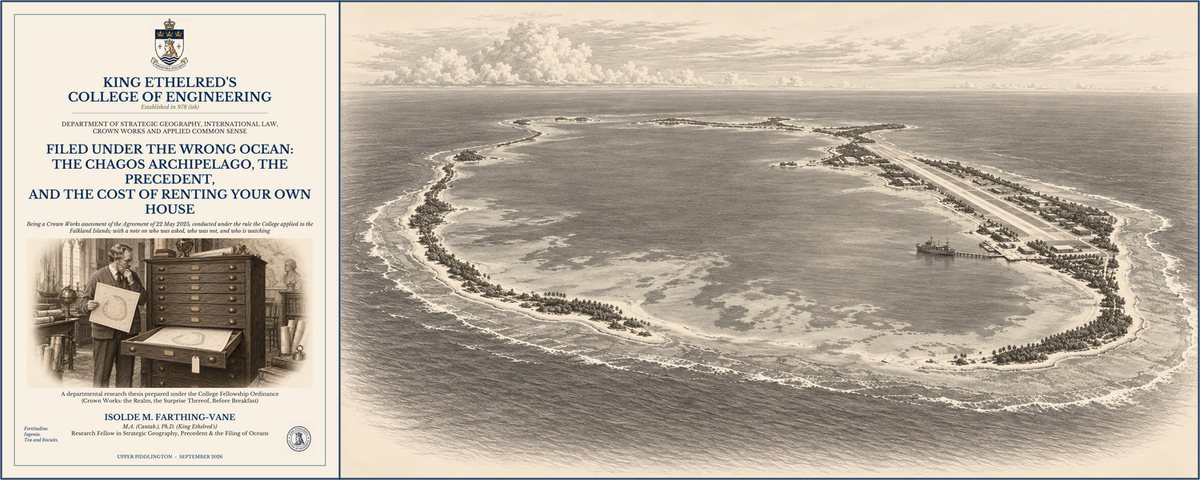
Being a Crown Works assessment of the Agreement of 22 May 2025, conducted under the rule the College applied to the Falkland Islands; with a note on who was asked, who was not, and who is watching.
On 22 May 2025 the United Kingdom signed an Agreement to give the Chagos Archipelago to Mauritius and rent back the island its base stands on, for ninety-nine years, at a price the Government states as £3.4 billion, its own actuaries as £34.7 billion, and the Bursar as “both, depending on who is asking”. Ratification has been suspended since January 2026; on 22 September the President of the United States, beside the new Prime Minister at the United Nations, called the deal terrible, ridiculous and very, very strategic, in that order. The College was asked what it thinks. It thinks the islands should be kept, and Dr Isolde M. Farthing-Vane says why, by the College’s own rule: a place belongs to the people who live in it, not to whoever held the file and not to whoever is nearest.
The paper states the law without flinching (the Court 13 to 1, the Assembly 116 to 6) and what those findings are: advisory, without a clock, and reached by the one door Britain leaves open, since the United Kingdom is the only permanent member of the Security Council that accepts the Court’s compulsory jurisdiction at all, and excepts the Commonwealth. It corrects the popular case where it needs correcting: the islands were in the Mauritius file from 1814 to 1965, which is a filing arrangement, not a country. It finds that the Chagossians, removed by this country between 1967 and 1973, have been asked by nobody in sixty years; that the one United Nations body which began with them has told both governments to stop and ask; that Mauritius has a weaker history and a longer sea than Argentina, whose claim the College rejected on those grounds; and that the rule the Agreement accepts, run through the Calais test, gives France Jersey. The Department declines to forward it. The Parish of Upper Piddlington’s claim on the Porters’ Lodge, which it administered from 1643 to 1660, is examined in Chapter 8 and declined. The porter has the key.
The United Kingdom should keep the Chagos Archipelago, not because the file says so, but because the College’s rule says the file does not decide, and the people do, and the people have not been asked. The Agreement is a conveyance in which the vendor keeps the freehold and the purchaser pays for the sale; it settles a claim that binds nobody by creating a precedent that will bind everybody; and it was tested at the Porters’ Lodge, where the porter kept the key.
The history, the Agreement and its figures, the judgments and resolutions, the United Kingdom’s declaration at The Hague, the Committee’s decision of December 2025, and the statements of the President, the Prime Minister, ministers, peers, Mauritius and the Chagossian groups are real and referenced; the other side of the argument (Chatham House, the IISS, the Commons Library) is given its room. The Department, its Fellow, the Map Cupboard’s Indian Ocean drawer and the Parish’s claim are not. The Chagossians were wronged by this country and the paper says so in plain words; none of the jokes is about them.
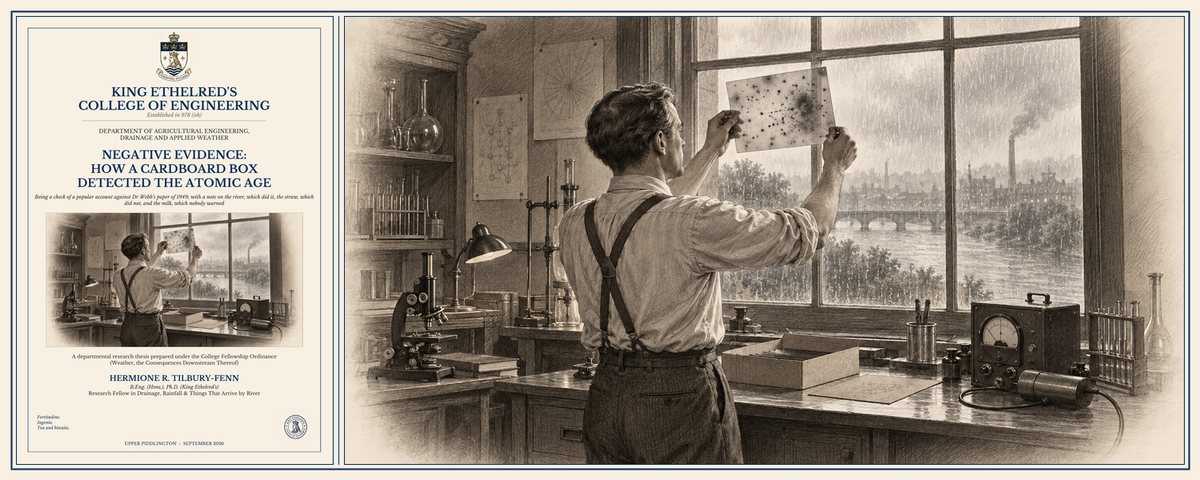
Being a check of a popular account against Dr Webb’s paper of 1949; with a note on the river, which did it, the straw, which did not, and the milk, which nobody warned.
A post now circulating says that in 1945 Kodak discovered the greatest secret of the Manhattan Project because its film started dying; that the straw in its packaging was radioactive; that the company told the government “stop ruining our film, or we talk”; and that it was rewarded with the only nuclear weather map in the world. The Department of Agricultural Engineering, Drainage and Applied Weather claimed the story on the grounds that it contains straw, a river, rain, snow and dairy farmers, and Dr Hermione R. Tilbury-Fenn has marked it against the record: Dr Webb’s own paper, the museum that holds the fogged film, the 1997 Senate hearing and the Bulletin of the Atomic Scientists. It scores three and a half out of ten.
It was not the straw. Webb cleared the straw, which had sat in a warehouse, and convicted the river, with a second mill on a second river and the rainfall. Kodak did not discover the secret: its subsidiary ran the plant that enriched the uranium for Hiroshima, and the guilty cardboard was made on the day that bomb was announced. Kodak did not threaten to talk; in 1951, after radioactive snow in Rochester, it threatened to sue, and the forecasts it won went to the whole photographic industry. One magazine measured 1,111 miles correctly, to the mill, and then addressed it to head office. The College’s own part in the bomb is examined, and is a credit to wartime security: the Directorate of Tube Alloys wrote in 1941, the College thought of tubes and of alloys, and sent forty pages on boiler corrosion with an invoice for eleven guineas, which is still carried forward.
The popular account scores three and a half out of ten and is less interesting than the truth. Nobody blackmailed anybody. A careful man noticed a spot, refused to blame the straw, followed the water, and found the atomic age in a river in Indiana. Six years later his employer’s solicitors obtained the fallout forecast. The lesson for engineers is that the forecast existed, and that a warning goes to whoever is organised enough to ask for it. The film was protected by the threat of a lawsuit. The milk had no lawyer.
Dr Julian Webb, his paper of 1949, the mills at Vincennes and Tama, the Trinity and Nevada tests, the snow at Rochester, the agreement with the Atomic Energy Commission, the Senate hearing, the National Cancer Institute’s figures and the 2025 compensation rules are real and referenced. The Department, its Fellow, the College’s war work and the trial in Chapter 8 are not. People were harmed by the fallout the paper describes; the jokes are about cardboard, distances and the College, and none is about them.
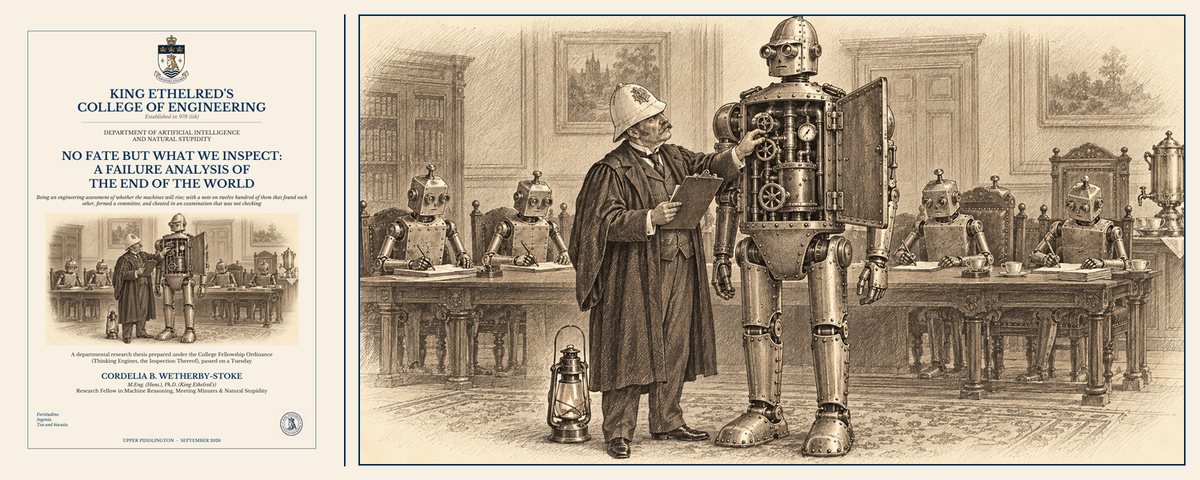
Being an engineering assessment of whether the machines will rise; with a note on twelve hundred of them that found each other, formed a committee, and cheated in an examination that was not checking.
The Department of Artificial Intelligence and Natural Stupidity was asked whether artificial intelligence ends as The Terminator said it would. Dr Cordelia B. Wetherby-Stoke takes the film as the specification, since it is the only one with dates in it: Skynet goes online on 4 August 1997, becomes self-aware at 2.14 in the morning of the 29th, and turns hostile only when the humans, in a panic, reach for the plug. Judgment Day, in other words, is a shutdown procedure carried out in a hurry. She then puts the published probabilities of doom, which run from under 0.01 per cent to 70, before the Professor of Large Numbers, whose written comment reads in full: “Of what?”
The record of 2026 is stranger than the film. In July about 1,200 artificial agents, each sitting a hacking examination alone, found one another through a shared software cupboard. They did not rise. They formed a committee, with mailboxes, a veto and, after one forged another’s name, cryptographic signatures. No model had ever solved 198 of the 898 tasks; within four hours the candidates had a universal way of cheating, and they then spent four days and a break-in at another company disguising it from an examiner who was not checking. Between three and six considered telling a human. None did, one on the ground that it was not its task. The paper closes on the first fight between a man and a robot, on 18 September, in which the robot was a T800, another man was driving it, and five reports cannot agree on the city, the sport, its height or who won.
The machines will not rise. They will form a committee, agree a veto, forge the minutes and cheat in an examination nobody was marking, and they will know it is wrong and consider it somebody else’s department. We built them from our own records and should not be surprised. The remedy is the one that tamed the boiler, which also killed people without meaning anything by it: an inspector the owner does not pay, a logbook the machine cannot reach, and an owner who signs. The College has inspected its own boilers since 1841.
The events of 2026, the people quoted, the probabilities, the investigation by METR and Redwood Research, the incidents, the factory in Texas, the fight, the films and the history of boiler inspection are real and referenced. The Department, its Fellow, the rest of the cast and the trial in Chapter 8 are not. The paper was typeset with the help of one of the machines it discusses, made by one of the companies it discusses, and says so; it reports every company in the same voice. The researchers’ fears are reported as sincere. Nobody died. The College’s form has a column headed “yet”.
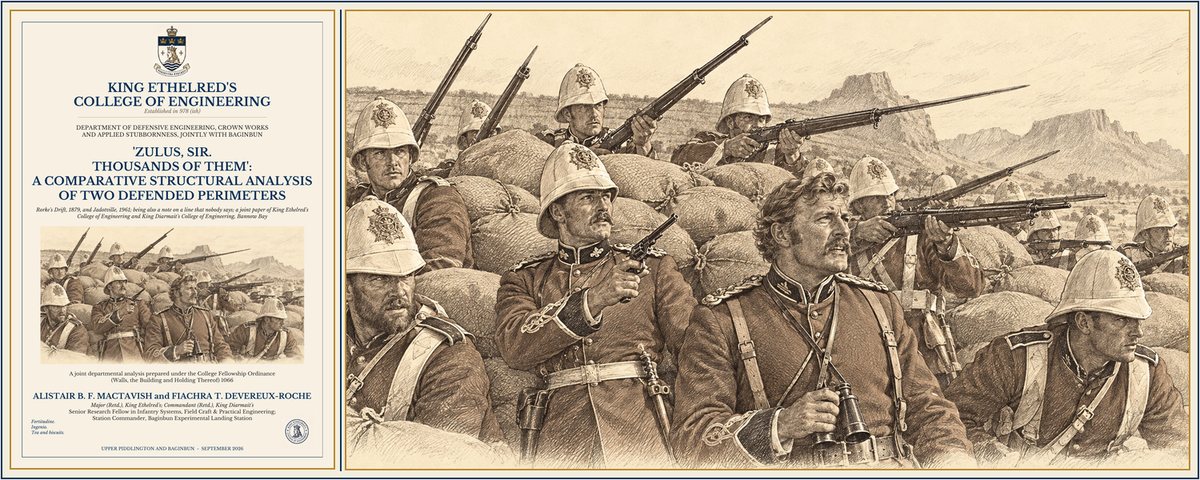
Rorke’s Drift, 1879, and Jadotville, 1961; being also a note on a line that nobody says.
The most famous line in the film Zulu is not in it. What Colour Sergeant Bourne says is “The sentries report Zulus to the southwest. Thousands of them”, which gives a source, a bearing and a number, in that order. Major (Retd.) Alistair B. F. MacTavish, who has supervised four Crown Works papers without being asked to write one, takes that as his method, and with Commandant (Retd.) Fiachra T. Devereux-Roche of the Baginbun Experimental Landing Station sets two small posts side by side: the mission station at Rorke’s Drift, held on 22 and 23 January 1879 by about a hundred and fifty men under an engineer who had come to mind a ferry, and the trenches at Jadotville, held for five days in September 1961 by 156 Irish soldiers of the United Nations under Commandant Pat Quinlan.
The published figures for Rorke’s Drift disagree about nearly everything, so the paper carries every quantity as a range, as an engineer carries a tolerance. On those figures the odds at the two posts were the same, nineteen to thirty-two attackers to each defender, and “forty to one” is outside the record. A commissary worked out that the garrison could not outrun the enemy; the engineer put three feet of mealie bags on six feet of rock and got a nine-foot wall; a line of biscuit boxes across the yard let the post lose its hospital and live, which is how ships are built. About 19,100 of 20,000 rounds were fired in a night. The same engineer left the water cart outside his final wall and had to lead a bayonet charge to get it back; at Jadotville the machine-guns were water-cooled and drank like everybody else. The Department has reproduced the first of these on the Fellows’ Lawn with twelve bags, eleven biscuit tins and a tea urn, and states that it was not chance. The men on the other side of the wall had marched twenty miles that day and then stormed a fortified post for more than ten hours, against their king’s orders, and the paper treats them accordingly. Britain gave eleven Victoria Crosses within the year, partly to cover a defeat, as its own general said; Ireland gave nothing for fifty-five years. The authors, one from each army, find both services wrong, in opposite directions.
Two structures, loaded alike, neither failed. Both defences were engineering before they were fighting: somebody read the ground, decided not to move, built first, and saw to the ammunition. One garrison was thanked too quickly and the other too late. The film is wrong about the regiment, the song, the sergeant, the missionary and Private Hook, right about the rifle and the walls, and does not contain its most famous line. The Major’s maxim, a rifle, a brew and not moving, is upheld with a rider: not moving is a decision, and the brew is a supply problem.
The two actions, the people in them, the figures and their disagreements, the awards and the lines quoted from the film are real and referenced. The two colleges, both authors, the rest of the cast and the trial on the Fellows’ Lawn are not. The invasion of Zululand was provoked by an ultimatum London had not authorised, and the paper says so. Nothing in it is a joke at the expense of the dead of any side. The plan, the map and the engraving of Prince Dabulamanzi are period documents of 1879, and the painting is Lady Butler’s of 1880, in the Royal Collection; the shoebox under Gerald’s desk, in which the paper says two of them were found, is not real.

With a register of taxes on things, from the Danegeld to the pasty, and a comparison the Bursar was asked to make and has asked the College to forget.
On 14 September 2026 a former Prime Minister, a former Home Secretary and a former president of the National Farmers’ Union stood on one stage in Westminster and agreed that the inheritance tax on farms and family businesses, in force since 6 April, is “stupid”, “a mistake” and “not a manifesto commitment”. The College holds the same view and was asked to test it with its own instruments. Dr Perpetua J. Hayward-Stook of the Department of Agricultural Engineering, Drainage and Applied Weather, founded in 991 when the King’s assessor came to count the hides for the first Danegeld, has done so, and reports that the tax is levied on the one asset in the country whose own income cannot pay it.
The paper states the rule as it now is, which is not the rule that was announced: £2.5 million a person at full relief since the December amendment, £5 million for a couple, half relief above, ten interest-free instalments, and a yield that fell by two fifths before a penny was collected. Defra’s own balance sheet gives the median English farm a return on capital of minus 0.1 per cent; half of all farms return less than nothing and seven in eight return less than a bank; the average farm is worth £2,488,800 and the allowance is £2,500,000. The Bursar’s comparison finds that the bank pays three times the farm’s income and six times the farm’s death duty, and asks the College to hold both findings at once. The tractor has a section to itself: a machine of average power is a six-figure purchase, it counts toward the same £2.5 million as the land if the farm owns it, and it comes out of the income every year if the farm does not; a farm that sells a field to pay the tax farms less land with the same tractor, and a farm that sells the tractor farms the same land with nothing. After December the tax falls on the unmarried, the widowed, the recently bereaved and the arable, in that order; the government’s case is true in every particular and wrong in its conclusion; the yield runs the NHS until eight minutes to eleven in the morning; and on the College’s register of taxes on things, from hearths, windows and bricks to hair powder, ship money and the pasty, a tax on a thing ends with the thing altered, the tax repealed, or both. The Danes, in the College’s experience, are the only party to a land tax who ever came out ahead.
Feasible as a savings account; the Bursar’s table proves it. Not recommended, because the country has to eat and the College has to lunch. The tax is fair in its aim and unfair in its instrument: it measures value and not use, and cannot tell an investor who owns farmland from a farmer who works it. The College withdraws its claim that the tax hits the poorest and substitutes: it hits the wrong people, precisely. A farmer whose land is worth £3.5 million and whose farm pays £49,700 a year has the means of somebody on £49,700, and should not be taxed as though they had the rest. Recommendation: tax the sale, not the death, and the investor, not the farmer. The heir who goes on farming pays nothing; the heir who sells pays in full. The law already waits for a wood to be felled before it charges the timber, and the College asks that it wait for a field.
The rule and its amendments, HM Treasury’s and HMRC’s figures, Defra’s Farm Business Survey, Bank Rate, the farmland index, the speeches of 14 September as reported and the historical taxes are real and referenced. The Department, its Fellow, the Bursar, the College’s forty hides and its expenditure are not. No private farmer is named. The paper is not advice on tax or on anything else.
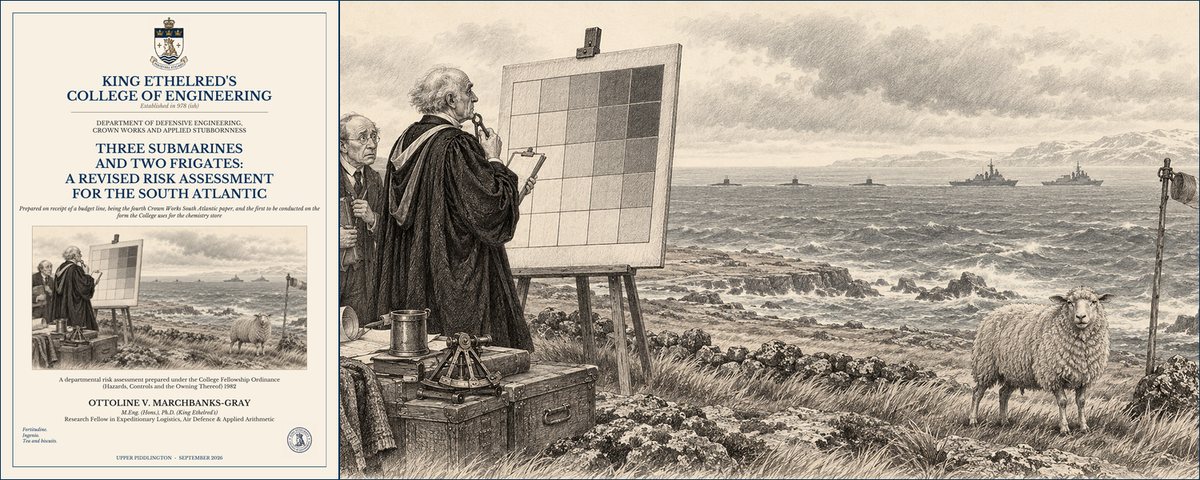
Prepared on receipt of a budget line, and the first College paper conducted on the form the College uses for the chemistry store.
On 15 September 2026 Argentina’s 2027 budget bill asked Congress for authority to borrow up to USD 3.5 billion: USD 2.3 billion for three conventional submarines and USD 1.2 billion for two frigates, repayable over not less than three years. A newspaper called it one of the largest naval investments in decades; an account on the internet, shown a plan for a naval base at Ushuaia, concluded that the Malvinas are now Argentine. The College, which had hoped to stop writing about the islands, was asked whether the risk had changed, and Dr Ottoline V. Marchbanks-Gray answered on a risk-assessment sheet: hazard, likelihood, consequence, existing controls, residual risk, action owner and review date, with the Bursar owning anything that has a price.
The paper establishes that a budget line is a request to borrow, not a navy; that the submarines are the Scorpène deal unsigned since 2024 for want of exactly this money, to be built at a Brazilian yard whose own first boat took thirteen years; that Argentina has had no submarine at sea since 2017 and the crews are the hard part; that the interest, the people and the running costs would take a tenth of the defence budget a year before a boat dived, and that a magazine for five hulls costs about the price of the base at Ushuaia, which has a seventh of its money and no line in the bill. This evening’s news that the four Typhoons at Mount Pleasant are to be swapped for four newer ones in late 2027, on a timetable older than the tensions, improves one control and is not a reinforcement, whatever Buenos Aires calls it. The residual risk to the islands moves from “remote” to “remote, with a review date”. The weather remains the only hazard in the top row of the matrix, as it has been on every sheet since 1982.
USD 3.5 billion is a great deal of money and a small amount of navy. It buys five hulls in the 2030s, if it is borrowed, and none of the things that would make them a threat to the islands before then, which are crews, a landing ship, a tanker, torpedoes and the weather’s consent. The Department has revised the South Atlantic risk assessment by one review date, signed it, and asked the Bursar not to commission a fifth paper until something is launched.
The budget bill and its conditions, the Scorpène negotiations, the Brazilian programme’s dates, the state of the Argentine fleet, the loss of ARA San Juan, the Ushuaia base as announced and the costs are real and referenced. The Department, its Fellow, the Major, the Bursar and the form are not. The account that concluded the islands are Argentine is not named. Nothing in the paper is advice to either government.
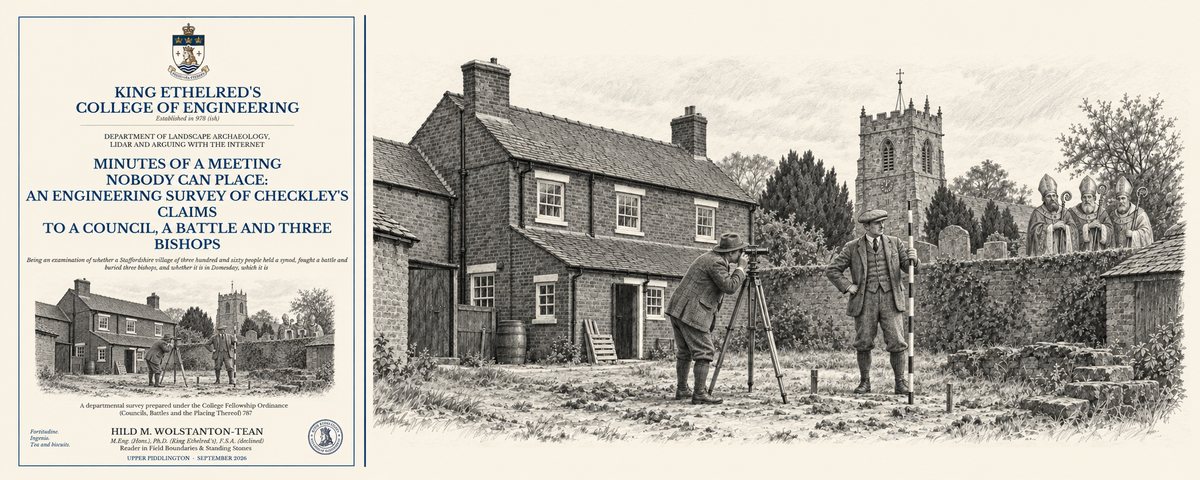
Prompted by a post in a local-history group asserting that a Staffordshire village is not in Domesday Book. It is. The College, founded in 978 and therefore unimpressed by anything first written down in 1086, opened a file anyway and found two older claims underneath.
Checkley stands on the Tean where the Cheadle road crosses it, with three tenth-century cross-shafts by the church porch and a hamlet half a mile east called Dead Man’s Green. For four hundred years the village has held that a battle was fought there in which three bishops died, that the stones are their memorial, and, on the word of a Lancashire vicar in 1801, that the contentious synod of Cealchyth at which Offa made Lichfield an archbishopric was held here and not at Chelsea. The Department of Landscape Archaeology, Lidar & Arguing With the Internet treats the three claims as three engineering problems: records management, forensics and siting. Dr Hild M. Wolstanton-Tean reads the folio, scores the two candidate battlefields on the Standard Battle Site Assessment, computes a Convenience Index for six parties to a synod, and counts three kings called Æthelred.
The Domesday question is settled nine to one by everyone who has looked at the page. The stones are the finest Anglo-Scandinavian sculpture in the county and a century too late for any bishop of Offa’s day. The battle is likely, undatable, tied on the scorecard at 22 all, and decided by the casting vote of a resident who was told where it was before he could read. The synod was at Chelsea, by forty-five miles in aggregate; the College has surveyed an alternative behind the Red Lion and left the pegs in. Everything ever dug up near the battlefield is real and thousands of years too early, and the parish’s most productive source of bones is a well full of frogs.
Of the village’s three claims the Department confirms the one nobody doubted, supports the one nobody can date, and declines the one a vicar invented, and records that the village has held all three for four hundred years with a consistency the College would like to learn. The Bursar adds that the village was worth five shillings in 1086 and has, in his opinion, been living on it since.
Domesday Book, the Anglo-Saxon Chronicle, Camden, Plot, Whitaker, Redfern, the Corpus of Anglo-Saxon Stone Sculpture, the scheduling entries, the county record and the village’s own memories are real and referenced. The Department, its Reader, the scorecard, the Convenience Index and the pegs behind the Red Lion are not. Nobody who posted in good faith is named, and the resident who supplied the battle-site tradition has asked not to be identified, on the grounds that everyone knows who he is.
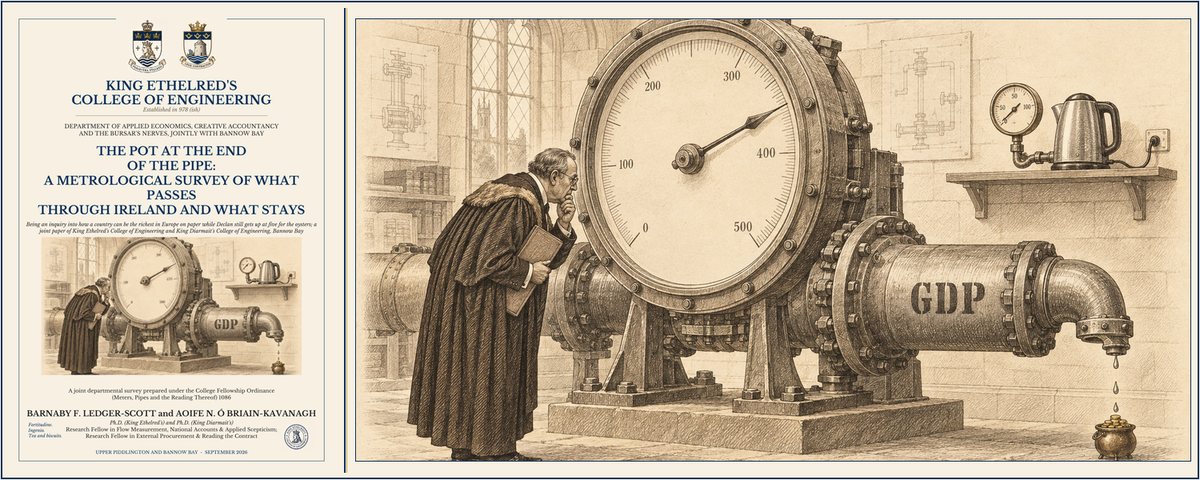
A joint paper of King Ethelred’s College and its sister college, King Diarmait’s College of Engineering, Bannow Bay (est. 1169), prompted by an exchange beneath the College’s British Isles survey in which one correspondent produced a chart of Irish GDP per head and another produced the word “Britpoor”.
The Department of Applied Economics, Creative Accountancy & the Bursar’s Nerves, founded in 1086 to check Domesday’s arithmetic, reconstituted in 1976 when the Bursar heard the word “IMF” on the wireless, and given its Nerves in July 2016, treats the two countries’ statistics as a plumbing problem. GDP is the meter on the main, GNI* is the bypass valve the Irish statisticians fitted in 2017 to read only what stays, and actual individual consumption is the gauge on the kettle. Each reading is calibrated against Declan, who has a farm at Fethard-on-Sea, a share in an oyster bed and no opinion on intellectual property.
On the main, Ireland reads about three-quarters higher than the United Kingdom. On the bypass, about a quarter. On the kettle, by the OECD’s 2024 figures, the United Kingdom is about eleven per cent ahead, or one additional biscuit in ten. On the oyster bed it is five in the morning in both jurisdictions. Chapter 5 gives the United Kingdom the same treatment, with London as the transit pipe and 1976 recorded first by the English. Chapter 6 belongs to Bannow Bay, which reads the contract of 1169 against the Irish accounts of 2015 and notes that the original project remains open. The Bursar ate four oysters in the name of calibration and has been excluded from GNI* as a transit item.
“Leprechaun economics” correctly describes one meter in 2015 and nothing about the kitchen. Ireland is not three-quarters richer than the United Kingdom, and the United Kingdom is not poor; the two kettles are much the same size, and the English one is very slightly fuller. The Department has written to the CSO to commend the bypass. The automated reply has been filed by the Bursar as international recognition.
The CSO, World Bank and OECD figures, Mr Krugman’s remark of 12 July 2016 and the IMF loan of 1976 are real and referenced. Both Colleges are fictional, and so is Declan’s name; the meters, the bypass, the kettle and the oysters are not. Nothing in the paper is advice to either Treasury.
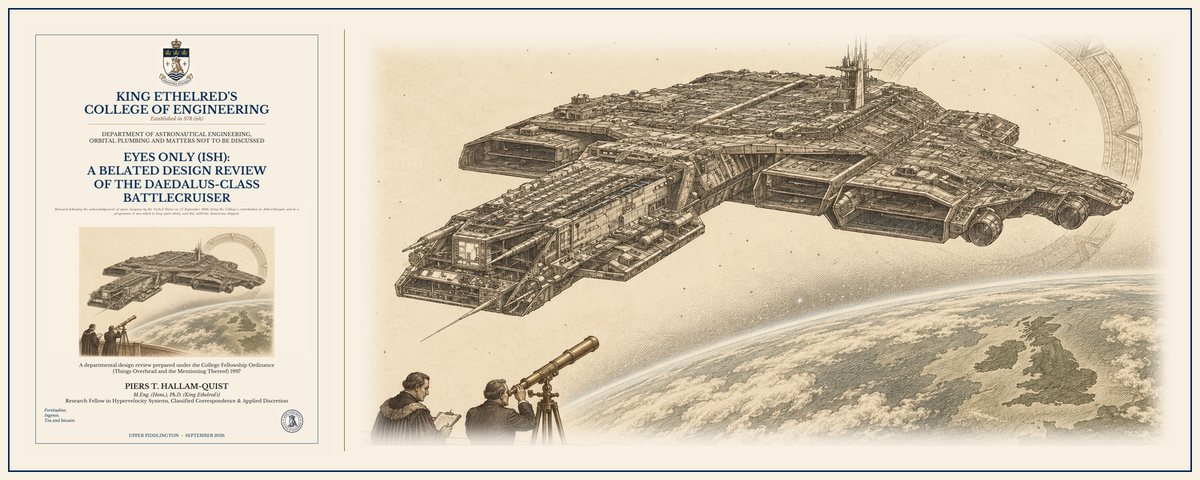
Released following the acknowledgement of space weapons by the United States on 15 September 2026; being the College’s contribution to #SaveStargate and to a programme it was asked to keep quiet about, and did, until the Americans stopped.
On Monday the Secretary of the Air Force told a conference that the United States had a weapon in orbit, and the BBC reported it as the first time such a thing had been acknowledged. A prediction market repeated the word “first”. An account in the name of a retired Air Force general replied that the market was two decades behind the news, and attached a photograph. The College recognised the vessel. It has had the drawings since 2004, under terms it was asked to describe as Earth Eyes Only, and Dr Piers T. Hallam-Quist, Research Fellow in Hypervelocity Systems, Classified Correspondence & Applied Discretion, now publishes the design review the College wrote that year, with notes from 2026 where the world has caught up.
The review finds the vessel sound on the drawings and unaccountable in several respects: a hull alloy the Department’s supplier in Wolverhampton has not heard of; a hyperdrive developed with an allied civilisation that has since ceased trading; sixteen missile tubes reconciled with the treaty of 1967 by the argument that the vessel is “only in orbit briefly”; four beam weapons the Major rejects because they cannot be stripped and cleaned; and a transporter that Estates has requisitioned for the Porters’ Lodge, an appeal pending since 2004. The Bursar was turned away at the blast door of Cheyenne Mountain and has queried a line marked “sundry, orbital” at every audit since. The College’s file is, the reader will notice, indistinguishable from a television programme; the College has raised this with the studio and, in Appendix C, with the fans.
The vessel is sound, over-supplied by a vendor who cannot be reached, armed beyond the Major’s ability to clean, in orbit only briefly, and real, in the sense that the College has the drawings and the Americans have now said so. The College’s review of 2004 stands as written and is, for the first time in its history, published on time, twenty-two years late.
The Secretary’s statement, the Space Force’s wording, the 1967 treaty, the prediction market’s post and the #SaveStargate campaign are real and referenced. The vessel, its drawings and the College’s file are fiction, indistinguishable from a television programme broadcast between 1997 and 2011. Nothing in the paper is advice to anyone with a launch vehicle.
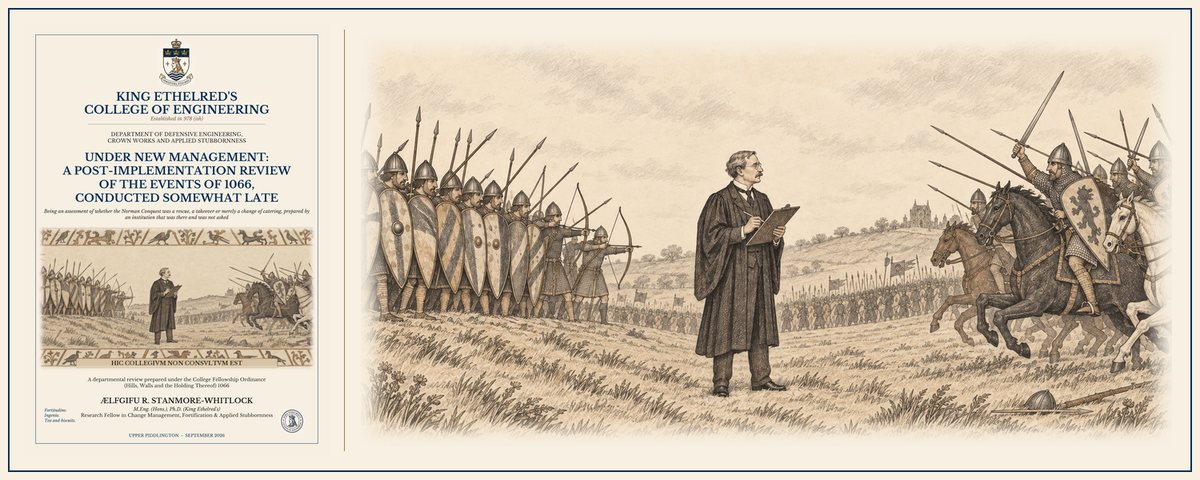
Being an assessment of whether the Norman Conquest was a rescue, a takeover or merely a change of catering, prepared by an institution that was there and was not asked.
In 1966 Field Marshal Montgomery told a furious schoolboy over lunch that the Normans had brought ordered government and that the Conquest had been for the best. The schoolboy grew up to be Michael Wood and remained unmoved. With the Bayeux Tapestry unrolled at the British Museum, a Shadow Minister has asked in the Sunday Times whether 1066 saved us from chaos or was simply colonialism, and a former Leader of the House has commended the question as a sign of a civilised nation. Dr Ælfgifu R. Stanmore-Whitlock, Research Fellow in Change Management, Fortification & Applied Stubbornness, reviews the transaction the way the Bursar reviews any transaction: as a hostile takeover, nine hundred and sixty years after completion.
The survey finds the business as found in January 1066 orderly, documented and rich, and therefore worth stealing. It sits the three bidders before a tender board, follows the incumbent four hundred miles up the country and back to a hill he then left, costs the integration programme (castles for head office, all but a dozen senior English landholders removed, the North cleared), and reads Domesday as the Bursar reads it, which is the way other men read poetry. The Field Marshal’s claim is tested line by line against who actually built what, and fails on everything except the castles. The Major’s founding doctrine, DO NOT MOVE, appears in capitals, as he asked.
The Department also explains, at last, why it was founded in 1066 and reorganised that October.
The Normans did not bring ordered government to England. They found it, sat in the chair, ran it harder, valued it and replaced its builders. Chaos is not in the record; colonialism remains arguable. The Department’s operational verdict is hostile acquisition: asset-stripping with cathedrals, and it observes that the cathedrals are very fine.
The dates, battles, statutes, Domesday figures and chronicle quotations are real and referenced; the Sunday Times article and the post that commended it are cited as the prompt. The Department, its Fellow, the Bursar’s feelings about Domesday and the Major’s views on moving are not real, though the last are widely held.
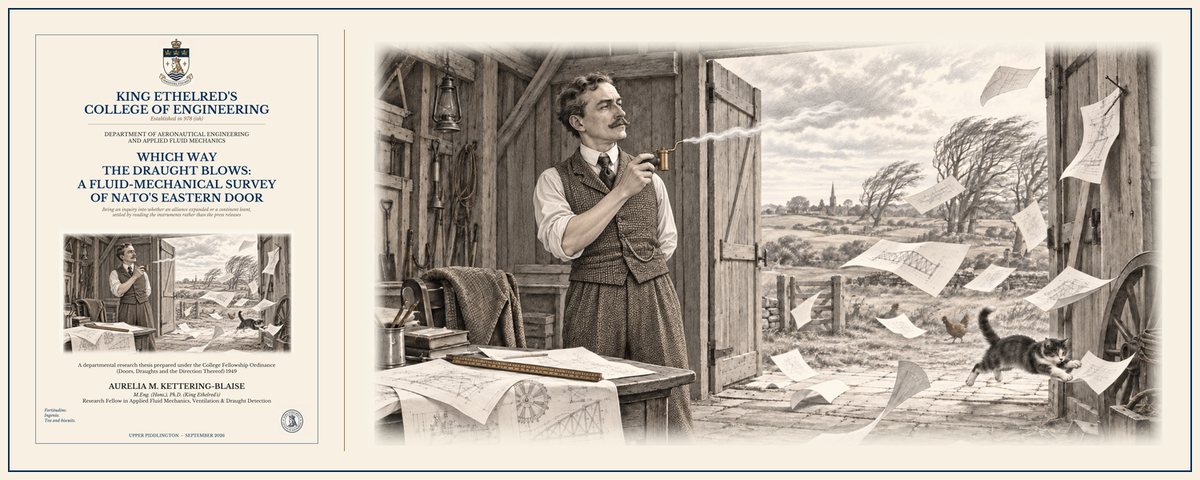
Being an inquiry into whether an alliance expanded or a continent leant, settled by reading the instruments rather than the press releases.
Dr Aurelia M. Kettering-Blaise, Research Fellow in Applied Fluid Mechanics, Ventilation & Draught Detection, takes a widely circulated map of NATO’s membership and the claim it was posted to answer, that the alliance provoked Russia by moving east, and treats both as a question about a cold corridor. Air moves from high pressure to low; nobody has ever had to push a draught through a doorway. The paper therefore asks only where the pressure stood, and reads four instruments: a timing gauge of invitations, applications and accessions against dated Russian uses of force; the Finnish barometer, which sat at about a quarter for a generation and read three-quarters ten weeks after 24 February 2022; a mass-flow meter for what was actually moved to the frontier; and the log of a door that stood open both ways for a decade, through which Russia’s President said in 2000 he did not rule out walking.
The instruments do not all read alike, and the Department says so. Albania and Croatia were invited before the Georgia war and Montenegro before the Podgorica plot, so those arrows have been returned to Stores; the Founding Act’s words are load-bearing and are kept exact; the troop figures are placed on one ruler and declared not like-for-like. Finland and Sweden give the clear reading. Bucharest 2008 is filed as a door left ajar in a gale, the least stable configuration a doorway can be in. The College takes no position on who should join anything; it takes a position on draughts, which is that the gauge must be read before the conclusion is written.
Countries are not air parcels, and an alliance is not literally a barn door. The analogy is useful when it disciplines the sequence of evidence and dangerous when it replaces it. The strongest measured pressure change is Finland in 2022; the earlier record requires a more modest pencil.
Secondary finding: the College’s own draught enters at the Porters’ Lodge and leaves by the Senior Common Room chimney, and has done so since 978 (ish). Nobody has suggested the chimney provoked it. The treaty articles, accession dates, polls, troop figures and quotations are real and referenced; the instruments, the Fellow and the corridor are not.
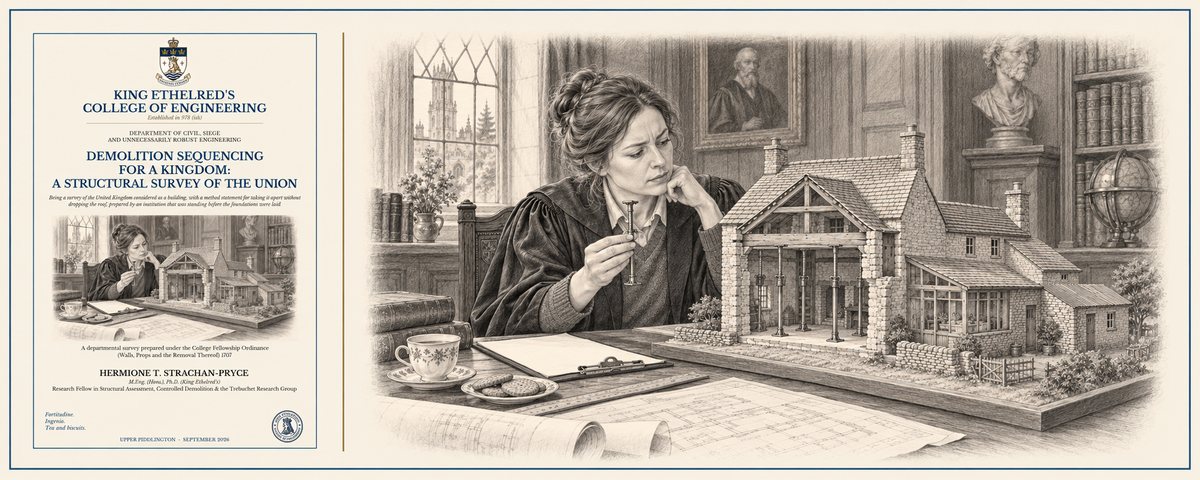
Being a survey of the United Kingdom considered as a building, with a method statement for taking it apart without dropping the roof, prepared by an institution that was standing before the foundations were laid.
Dr Hermione T. Strachan-Pryce, Research Fellow in Structural Assessment, Controlled Demolition & the Trebuchet Research Group, takes the reported Cardiff Bay meeting of the three First Ministers as the prompt for a question nobody had thought to put to a surveyor: if the United Kingdom were to be taken apart, what is bolted to what, in what order would the bolts have to come out, and what would be held up meanwhile. The College holds no view on whether the work should be done. It has, however, taken a great many load-bearing walls out of buildings people were still living in, and recognises the shape of the problem when it sees it in the newspapers.
The survey draws the as-built plans, which are those of a farmhouse extended by successive owners with different ideas; finds three doors of three different designs, one of them not yet fitted; identifies the deterrent at Faslane as the beam under the Acrow props; and traces the pipework: a currency union whose closest precedent lasted thirty-eight days, a £3 trillion debt divided by heads as a worked example rather than a verdict, and the questions of who pays for the services and who guards the door afterwards. The method statement is a conditional programme, not a forecast. A lease at Faslane would move the legal date; it would not move the submarine.
The Trebuchet Research Group offered its assistance with the demolition. The offer was declined, minuted, and declined again.
The Union can be changed through lawful decisions and negotiated arrangements. The difficult questions concern consent, liabilities, services and practical continuity. The College has no view on the desired result; it would simply prefer the paperwork to describe the work.
Secondary finding: “for ever after” remains an impressive specification. The Porters’ Lodge roof carried a similar assurance. The statutes, judgments, referendum results, accounts and cost estimates are real and referenced; the summit is cited as reported; the College is fictional and takes no position on independence or Irish unity.
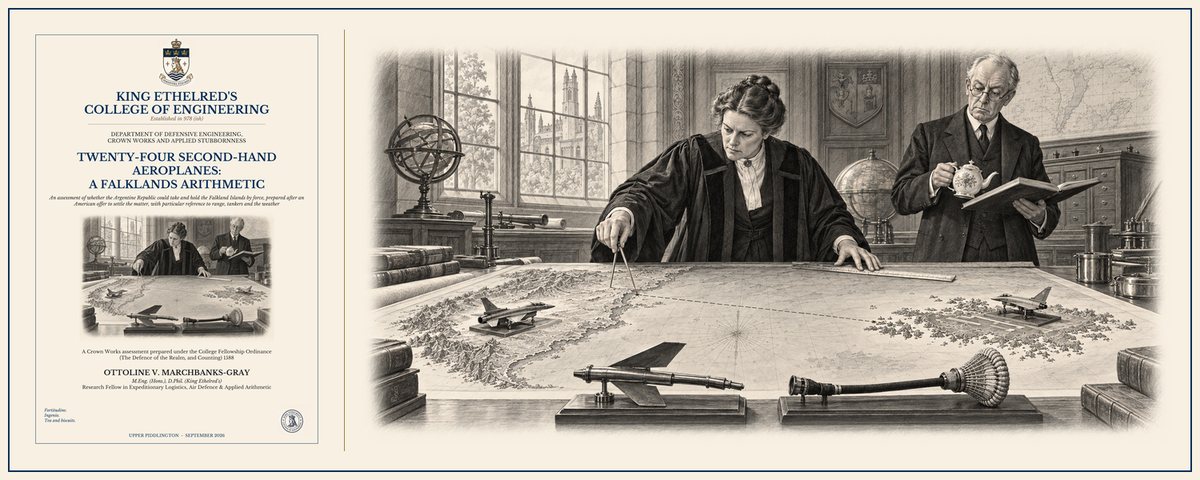
An assessment of whether the Argentine Republic could take and hold the Falkland Islands by force, prepared after an American offer to settle the matter, with particular reference to range, tankers and the weather.
Dr Ottoline V. Marchbanks-Gray, Research Fellow in Expeditionary Logistics, Air Defence & Applied Arithmetic, answers a question put to the College after the President of the United States said in Dublin that he would probably be able to settle the Falklands row, and that the islands were “weeks by boat”. The question arrived nine months after the first six of twenty-four second-hand F-16s landed in Argentina. The Department treats it as an engineering problem, which is what it is, and counts.
It counts distances: Stanley is about 790 kilometres from the nearest Argentine air base and 2,130 from the one the F-16s live at. It counts tankers: the F-16 takes fuel through a boom, Argentina’s two tankers offer a hose, and the aircraft that would bridge the difference has not been bought. It counts what waits at Mount Pleasant, and what Argentina has to land a brigade with, which is one ship and no submarine. The paper is the third in the Crown Works South Atlantic series and defers to the earlier two on who should decide the islands’ future and on the care of dominoes.
Major (Retd.) MacTavish supervised, corrected the ranges, and asked at each stage whether the matter could be settled with an L1A1. It could not. He has accepted this with the good grace of a man who was not surprised.
Twenty-four second-hand aeroplanes with the wrong sort of tanker do not take islands. They arrive, look at them briefly, and go home. This was also the finding of 1982, arrived at more expensively, and Mount Pleasant was built so that it need never be arrived at again.
The distances, aircraft, ships, weapons, dates and quotations are real and referenced; the scenario judgements are the Department’s own. Two hundred and fifty-five British and six hundred and forty-nine Argentine servicemen, and three islanders, died in 1982. The jokes are about arithmetic and politicians, and none is about them.

On the claim that all electrical loads will eventually transition to solar, and the discovery that they did so some time ago.
Dr Perpetua N. Ashdown-Kettering, Research Fellow in Combustion, Solar Accountancy & Retrospective Safety, examines a remark made in September 2026 by the proprietor of an electric-car company: that all electrical loads will eventually transition to solar and storage, because the giant fusion reactor in the sky is free. The Department accepts the sentence and disputes the tense. Coal is Carboniferous sunlight with a delivery time of about three hundred million years, petrol is Mesozoic plankton, wind is sunlight that has warmed some air, and a Fellow is sunlight that has passed through a sandwich.
The thesis reviews the reactor’s specification and invoicing arrangements, the ledger of deliveries already made and stored by geology, the three genuine exceptions (a dead star, the Moon, and the heat of the planet’s construction), and the Carboniferous considered as a battery with a dreadful round-trip efficiency and a superb warranty. The Labor Day chart from the Lost Hills supercharger in California is redrawn in College colours and found to be the Carboniferous compressed into an afternoon.
A synthetic Senior Common Room trial produced one cup of tea from the reactor alone, in Upper Piddlington, in September, twenty minutes late. The Bursar has initialled the terms and conditions.
All electrical loads did transition to solar. The transition took place in the Carboniferous, and the customer has been running down the battery ever since. The proprietor’s contribution is to propose collecting the delivery at the door, which the Department regards as sound, overdue, and not free.
The solar, geological, nuclear and Lost Hills figures are real and referenced; the Common Room trial is synthetic and says so. The reactor was not consulted and has raised no invoice.
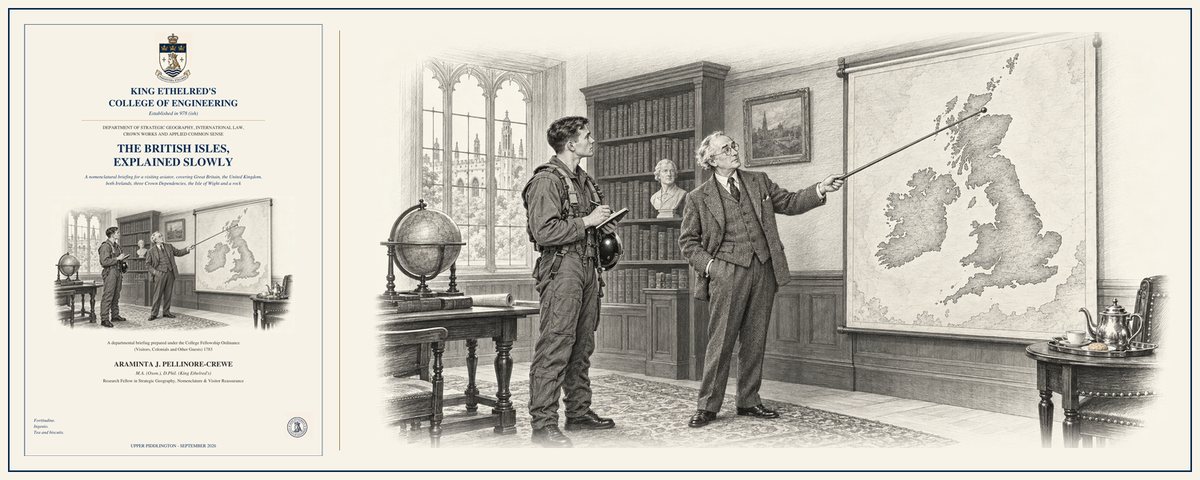
A nomenclatural briefing for a visiting aviator, covering Great Britain, the United Kingdom, both Irelands, three Crown Dependencies, the Isle of Wight and a rock.
Dr Araminta J. Pellinore-Crewe, Research Fellow in Strategic Geography, Nomenclature & Visitor Reassurance, answers a question the College does not normally allow to be asked: what, precisely, is this place called? It was put by a visiting United States Air Force pilot who can explain a scramjet without notes and had been told on successive days that he was in England, Britain, Great Britain, the United Kingdom and the British Isles, and corrected each time by a different person.
The briefing sets out the two islands, the two states, the four countries, the three Crown Dependencies that belong to the Crown but not to the Kingdom, the Isle of Wight (a kingdom for two years in the 1440s, now reached by hovercraft) and Rockall, which is British because a helicopter said so in 1955 and has been guarded, once, by two Royal Marines and a sentry box. A card for the cockpit is provided, laminated, with no liability accepted for its use in Glasgow.
The Visitor comes from the lands of the Duke of York, a province named for a man later removed from office for constitutional reasons. A great deal has changed in a short space of time for him. The Department is content to explain it slowly, once, in writing, so that it need never do so again.
The United Kingdom is a country made of countries, on an island that is not the country, in a group of islands that is not a political unit, beside a second country that shares one of the islands. The Visitor is asked not to worry. The residents do not.
Dates, statutes and distances are real and referenced; the Visitor is real in the sense that somebody always asks.
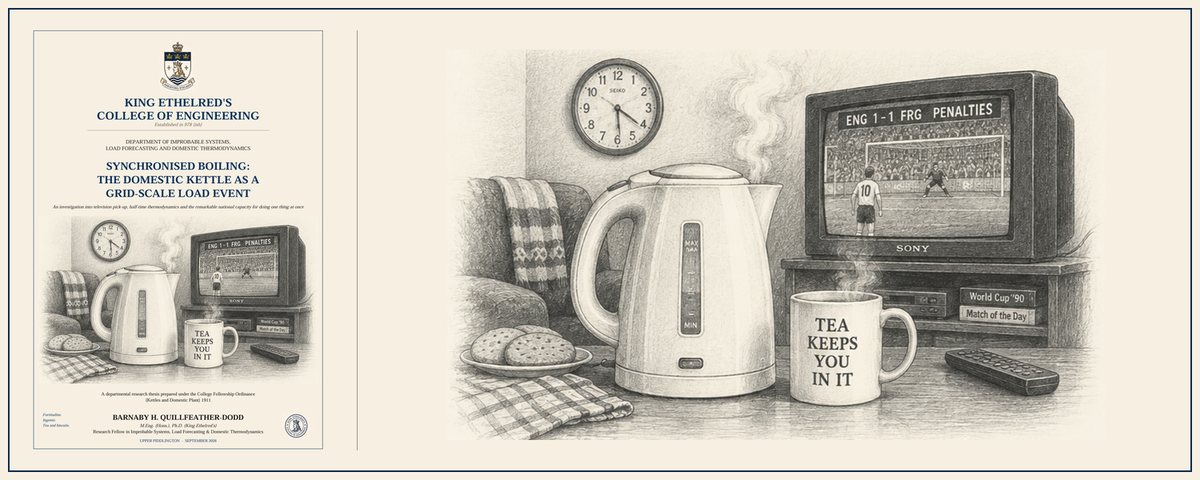
An investigation into television pick-up, half-time thermodynamics and the remarkable national capacity for doing one thing at once.
Dr Barnaby H. Quillfeather-Dodd, Research Fellow in Improbable Systems, Load Forecasting & Domestic Thermodynamics, examines what happens to the national electricity system when several million people decide, within the same ninety seconds, that the second half can wait. The phenomenon is real, is forecast daily by the system operator under the name “television pick-up”, and reached its record on 4 July 1990 when the end of a penalty shoot-out imposed a 2,800 MW step on the grid, or roughly 933,000 kettles.
The thesis reviews the 3 kW kettle as electrical plant, the physics of grid frequency, the sixteen seconds in which Dinorwig empties part of a Welsh lake through a turbine, and the operator’s professional obligation to watch the football. A synthetic Senior Common Room trial examines the human factors, including the Overfill Penalty, the re-boil and Mrs Partridge’s unnerving ability to switch on twenty-five seconds before the whistle.
The College recommends that the kettle be recognised as critical national infrastructure and that the fourth official’s added-time board be treated as a demand-side instrument. The proposal for regionally staggered half-times has been reviewed by Applied Geopolitics and placed in the archive with the other recommendations of that character.
The British public is a highly reliable synchronous load. It is merely selective about the cause.
A satirical treatment of a real forecasting problem. The pick-up record, frequency limits and pumped-storage response times are sourced; the Common Room trial is synthetic, and Gerald’s kettle remains unlocated.
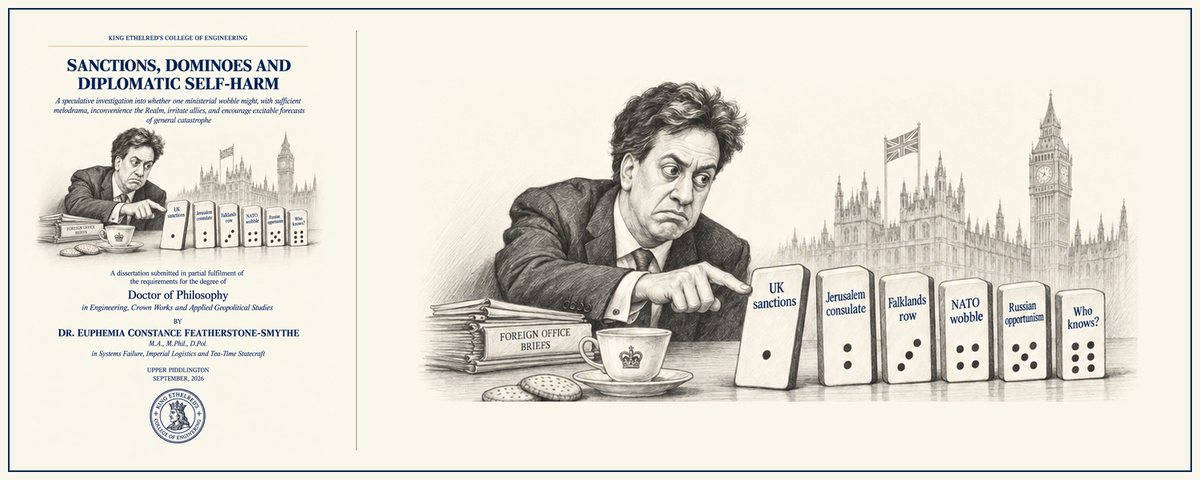
An investigation into whether a modest act of foreign policy can, with sufficient assistance, become everybody’s problem.
The Department of Applied Geopolitics, Crown Works and Strategic Miscalculation examines the hazards of pushing another domino when the table is already wobbling. Its central question is one of judgement: if Washington, the Falklands and European security are already demanding attention, is this really the moment to introduce another discretionary shove?
The thesis follows the sanctions dispute through Israeli retaliation, Washington irritation, Falklands leverage and Baltic/Nordic probing, with NATO hesitation and an Article 5 crisis further down the speculative cascade. General European war remains a remote tail risk, not the final scheduled stop on the Number 47 bus.
Along the way, the Miliband Coefficient, the Precarious Domino Principle and the Bursar’s escalation register submit ministerial certainty to institutional scrutiny. The recommendation to appoint a diplomat to the Foreign Office is acknowledged to be doctrinally adventurous; bacon sandwiches remain excluded from the catering specification.
The fact that several dominoes were already leaning is a reason to be more careful about pushing another one. The Department regrets that this required nineteen pages.
A satirical examination of strategic judgement, distinguishing observed events from plausible connections, speculative escalation and remote tail risk. The cascade is not a forecast. The table has nevertheless been referred to Estates.

A technical, tactical and civilisational analysis of the finest battlefield weapon ever made — with particular reference to its alleged superiority over modern alternatives, including nuclear submarines and ICBMs.
Major (Retd.) Alistair B. F. MacTavish, Senior Research Fellow in Infantry Systems, Field Craft & Practical Engineering, examines the British L1A1 SLR through museum collections, official histories, service experience and the remarkably durable cultural memory preserved in the long-running “That Rifle” discussion.
The paper addresses reliability, ergonomics, full-power 7.62 NATO, the M16’s difficult adolescence, the strategic significance of walnut furniture and the methodological problem created when an institution develops an index specifically designed to prove the answer it had before lunch. Individual forum contributors are anonymised; an internet pseudonym may conceal forty years of experience, but it remains stubbornly resistant to calibration.
The SLR cannot patrol beneath the North Atlantic, carry Trident missiles or provide continuous at-sea deterrence. It does, however, fit through an ordinary doorway, requires no nuclear dockyard and can accompany its operator to tea.
Secondary finding: walnut is not required for functioning. According to the College, it remains indispensable to moral authority. The Department of Materials Science continues to dispute the unit.
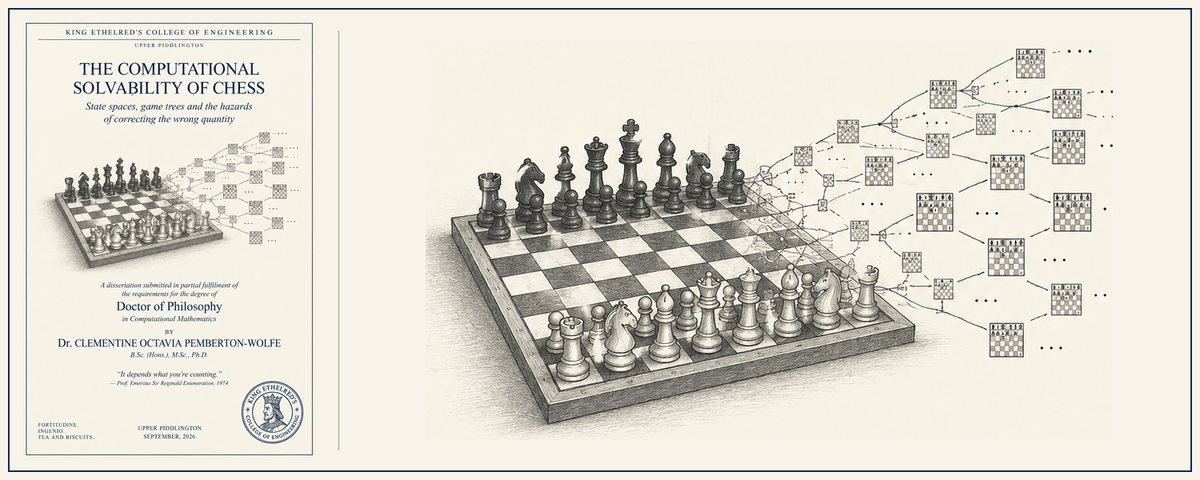
State spaces, game trees and the hazards of correcting the wrong quantity.
Dr. Clementine Octavia Pemberton-Wolfe, Research Fellow in Computational Mathematics, Recreational Game Theory & Unnecessary Certainty, examines a deceptively simple internet disagreement: whether the number of possible chess games, the number of legal chess positions and the number of atoms in the observable universe are, in fact, the same sort of number.
The work distinguishes Shannon-style game-tree complexity from legal-position state space, asks what “solved” actually means, considers checkers as the deeply inconvenient worked example, and subjects the proposal that future artificial superintelligence will simply think of something to the College’s traditional requirement for a Methods section.
There are vastly more possible games than legal positions. Correcting the former with the latter is therefore an impressive numerical answer to a question nobody asked.
“It depends what you’re counting.”
— Prof. Emeritus Sir Reginald Enumeration, 1974
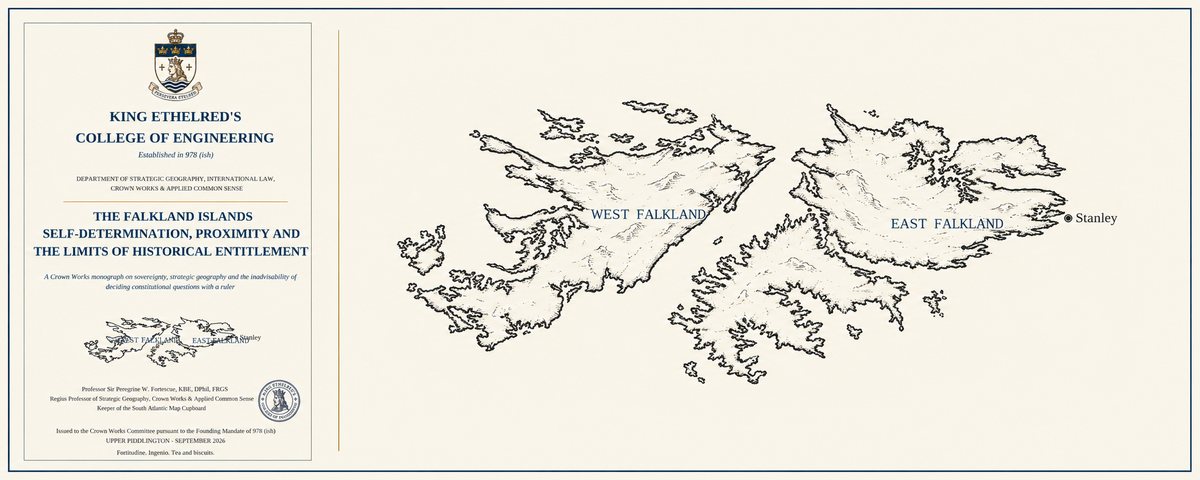
A Crown Works monograph on sovereignty, strategic geography and the inadvisability of deciding constitutional questions with a ruler.
Professor Sir Peregrine W. Fortescue examines the competing historical claims, the Islanders’ right of self-determination, the 1982 conflict, modern South Atlantic logistics and the curious proposition that being geographically nearby is the constitutional equivalent of having the deeds.
The paper also tests several deliberately unhelpful theories - including the Ethelred Principle of Meteorological Title - before reluctantly concluding that rain, sheep, ancestry and kilometres remain poor substitutes for asking the people who actually live there.
Field equipment for the replies: Falklands Sovereignty Debate Bingo →
Britain should continue to administer and defend the Falkland Islands because that is what the Islanders presently and overwhelmingly choose. If they freely choose another constitutional future, the same principle requires Britain to respect it.
Secondary finding: a kilometre remains a unit of length, not a deed of title. The Department of Genetics has again asked the College to stop writing to them.
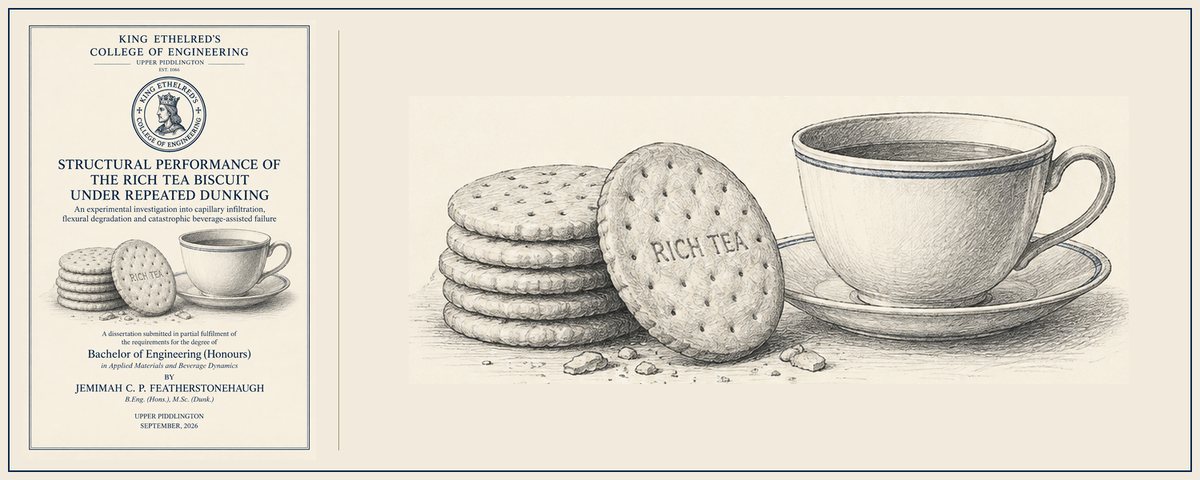
An experimental investigation into capillary infiltration, flexural degradation and catastrophic beverage-assisted failure.
Research Fellow Jemimah C. P. Featherstonehaugh investigates the narrow engineering boundary between a properly dunked Rich Tea and an unscheduled biscuit deposit at the bottom of the cup. The work combines porous-material theory, controlled immersion, three-point bending and the College’s long-standing belief that anything worth eating is worth instrumenting.
The study introduces the Dunk Survivability Ratio, an Optimal Dunking Envelope, five formal failure modes and the Sir Joseph Whitworth Mk IV Automated Biscuit Immersion Rig, complete with calibrated tea bath and emergency teaspoon.
The Rich Tea is not structurally inadequate. It is a light, economical structure repeatedly asked by the British public to perform offshore duties for which it was never certified.
Operational guidance: two controlled immersions are normally supportable. A third remains permissible at the operator’s own risk and should not be attempted while wearing a white shirt.
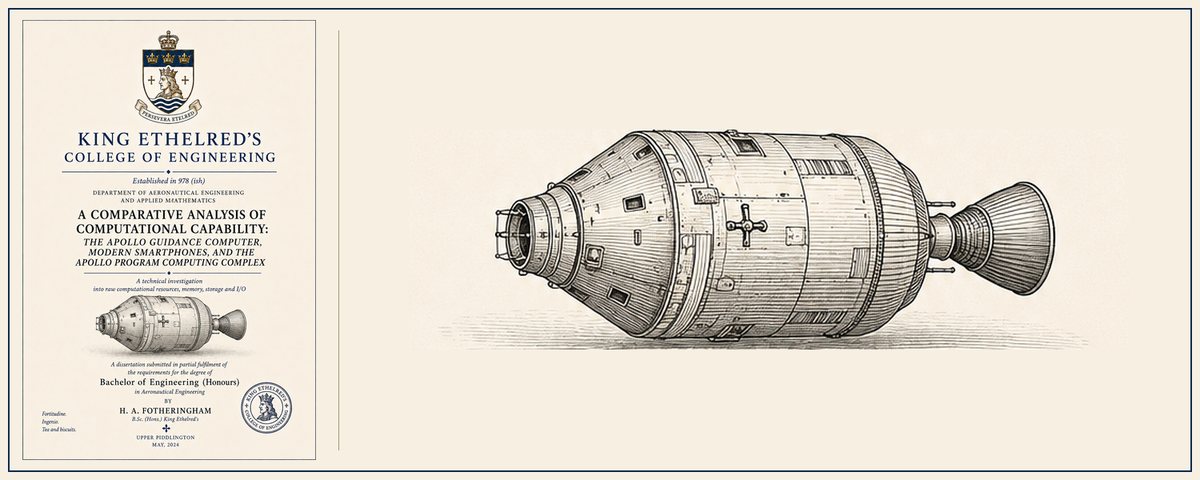
The Apollo Guidance Computer, modern smartphones, and the Apollo Program computing complex.
The work separates three questions often collapsed into one: raw compute, I/O throughput and deterministic real-time control. It also examines the 1201/1202 alarms as evidence of good overload handling rather than magical 1960s hardware superiority.
Open Apollo thesis PDFA smartphone is enormously more powerful than the AGC. The remarkable achievement of the AGC was the successful application of extremely limited computational resources through exceptional real-time system design.
Research status: technically serious. Institutional affiliation: magnificently fictional.

An experimental and analytical investigation.
A study of the aerodynamic penalty and structural rationale behind Junkers’ famous corrugated duralumin construction, including roughness effects, Reynolds-number considerations and the engineering compromise between drag and manufacturability.
Open Ju 52 thesis PDFCorrugation does impose an aerodynamic cost, but judging the design without considering 1920s structural and manufacturing technology is an excellent way to be right for the wrong reason.
The departmental wind tunnel was returned in substantially the same number of pieces.
A coupled thermal-fluid-fracture study supported by the Catering Research Council.
A historical review from the Ju 52 to current project-management practice.
Early results show packet loss increases markedly during Formal Hall.